


New Research Reveals Gen Z is Rewriting the Rules of Customer Experience

Your CX program might be missing key insights from younger generations. Discover what motivates younger consumers to provide feedback and how to adapt your strategy to build trust with the next generation of consumers.
Beyond being CX professionals, we’ve all been there as consumers: a receipt arrives in your inbox, and a company asks you to “take a quick survey.” Sometimes you click. Other times you don’t. But what drives that decision, and does it differ depending on whether you’re a Gen Zer, Millennial, Gen Xer, or Boomer?
That’s exactly the question our latest research, Research Report: Why Gen Z is Reshaping CX Strategies, set out to explore. We asked consumers across generations to share what motivates them to provide feedback, and the key characteristics of that feedback when they do. The goal wasn’t just to gather data points, but to uncover the deeper drivers that explain when and why people decide their opinions are worth sharing.
Let’s explore some of the biggest findings.
Many wonder about the value of being questioned
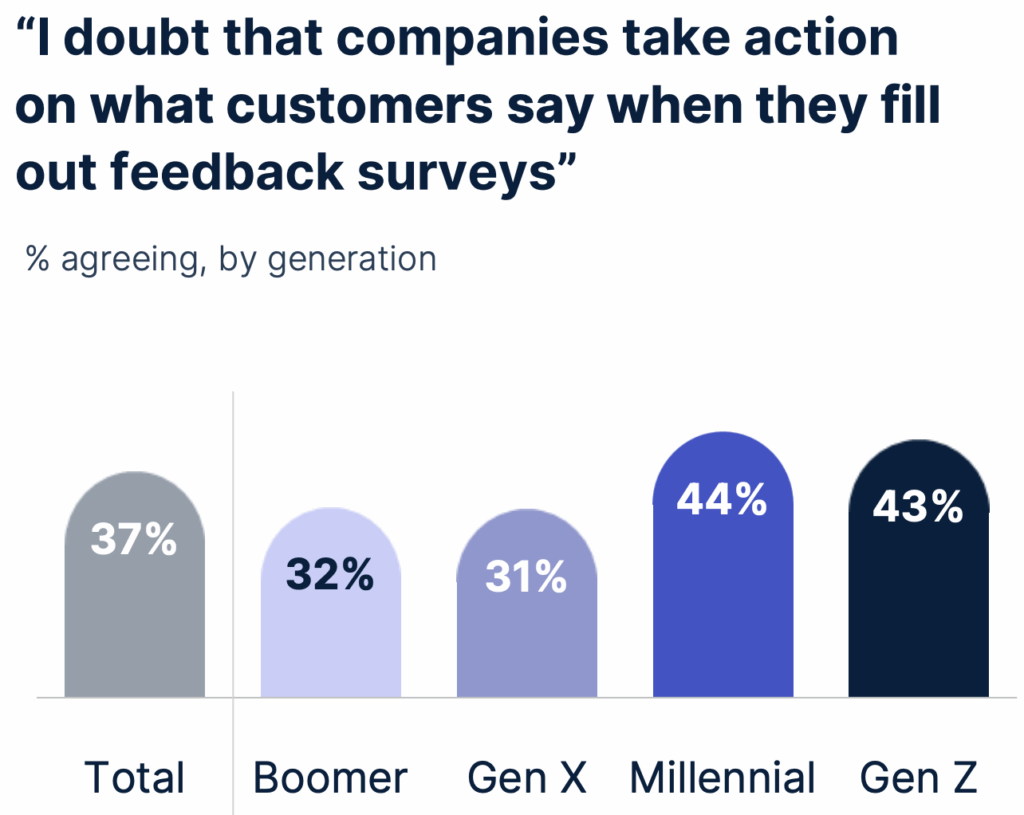
Half of consumers feel feedback requests are more common now than in the past. But it’s not that consumers are unwilling to share their thoughts, it’s that many no longer believe it makes a difference. Our data shows this skepticism is especially pronounced among Millennials and Gen Z, who are more likely to doubt that companies take action on feedback. For CX leaders, that should be a flashing red light: if the next generation of customers assumes their voice won’t be heard, they’ll stop speaking up altogether.
The implications go well beyond survey response rates. When customers feel ignored, they’re less likely to invest in the relationship, less likely to advocate, and more likely to churn. The challenge isn’t just to collect feedback, but to close the loop in a way that is visible and meaningful. CX professionals should ask: How often are we telling customers what changed because of their input? And are we designing feedback programs that connect directly to improvements in products, services, or policies?
Gen Z isn’t a silent generation — you just might not be listening to them
A common assumption is that younger generations, especially Gen Z, are less inclined to fill out surveys. After all, they’re known for shorter attention spans and a preference for quick, frictionless digital interactions. But the data tells a different story: across generations, participation rates are surprisingly consistent. Gen Z might roll their eyes at a feedback opportunity, but they’re also not opting out at significantly higher rates than their Millennial, Gen X, or Boomer counterparts.

The nuance comes in where they choose to speak up. Younger consumers in particular may be just as willing to share feedback, but they’re more likely to do it outside the company’s four walls on platforms like Yelp, Google Reviews, or social media. They actually are nearly twice as likely as Boomers to have most recently submitted their most recent feedback through a third-party site or social media platform.
For CX professionals, that’s both a risk and an opportunity. If feedback is flowing elsewhere, how are you capturing it, analyzing it, and responding to it in ways that show customers you’re listening? Closing the loop now requires looking beyond the survey form and building strategies that treat all feedback (whether on your site or someone else’s) as part of the customer experience ecosystem.
Is Gen Z actually the true generation of “Karens”?
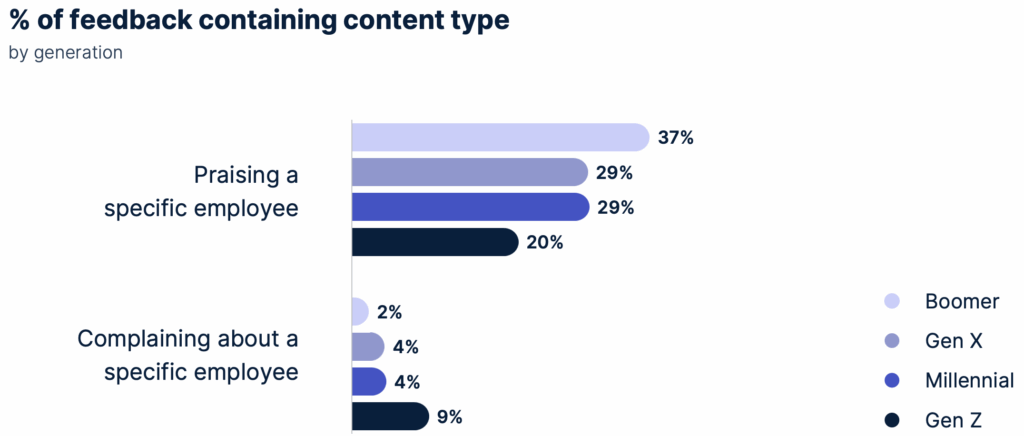
The stereotype of the “Karen” has typically been pinned on cranky middle-aged consumers, but our research suggests Gen Z might actually deserve the label more. They are the least likely generation to report being satisfied during a customer experience, and when they do provide feedback, it’s more often critical than that of older generations. Unlike Boomers, who are more inclined to call out great service from a specific employee, Gen Z is relatively likely to lean into pointing out what went wrong.
For CX leaders, this isn’t just a quirky generational trait. It has real implications for how metrics are interpreted. If your survey responses increasingly skew younger, you may see Net Promoter Scores or satisfaction ratings drift downward, even if the actual experience hasn’t deteriorated. Similarly, a new outreach campaign that draws in more Gen Z respondents might look like a service failure when in fact it’s a shift in who’s speaking up. The “so what” is clear: don’t just track the numbers, track the composition of your respondents. Understanding who’s behind the data is as important as the score itself, and it’s the only way to know whether you’re seeing a true signal about experience quality or a reflection of generational expectations.
Boosting feedback participation: a mix of feelings, ease, and incentives
It’s no surprise that the biggest nudges toward participation come at the extremes. Customers are far more likely to share feedback after an especially positive (or negative) experience, and they’re quick to disengage if a survey feels too long or requires annoying steps like logging into an account. Those transactional details matter, but our research shows they’re only part of the story.
Many of the strongest motivators aren’t about the experience itself, but about the relationship with the brand. Customers are more willing to respond if they have a longer history with a company, if they view it as trustworthy, or even if it feels like a smaller, more human “mom and pop” business. That means participation isn’t just about asking the right questions in the right format, it’s about the emotional context surrounding the brand.
Also worthy of note: the higher inclination to participate when requests come via text message or can be completed on social media or a third-party site. Gen Z especially over-indexes on those.
For CX leaders, the takeaway is clear: boosting participation isn’t only about survey mechanics. It’s about strengthening brand connection, meeting customers in their preferred channels, and recognizing that willingness to respond is as much emotional as it is functional.

When it comes to motivating customers to take a survey, it is no surprise that cash is king. Guaranteed money tops the list of preferred incentives, and when that is not available, customers are quick to point to close substitutes like loyalty points, discount codes, or entries into sweepstakes. These tangible rewards make the exchange feel worthwhile, especially when the survey itself requires time and effort.
But incentives do not always need to hit the budget line so harshly. Our research shows that other forms of value can be just as appealing, particularly among Gen Z. This group is more open to perks like early access to product launches, limited edition branded merchandise, invitations to local events, or special recognition statuses. These alternatives may be more financially palatable, and at the same time strengthen the emotional bond with customers. For CX professionals, the key is to think creatively. Incentives can be more than a transaction; they can be an extension of the brand experience itself.
Take action to better understand Gen Z
Gen Z is reshaping how feedback should be thought about and acted on. They are just as likely to participate as other generations, but their expectations and behaviors look different. For CX professionals, that means adapting strategies now to build trust with the next wave of customers—and rethinking what “listening” really looks like.
Here are a few clear steps forward:
- Close the loop visibly – Do not just thank customers for feedback; demonstrate what changed because of it. Share outcomes in-app, on social channels, or even in marketing campaigns so Gen Z can see that their voices matter.
- Listen outside your four walls – Traditional surveys are only part of the story. Capture insights from third-party review sites, social media, and influencer conversations where Gen Z naturally shares opinions.
- Expand the insights from interactions already taking place – Pair survey data with conversational intelligence from customer service calls and chats, or with digital experience analytics. This gives you a more complete picture of the experience as customers actually live it.
- Tailor outreach – Meet Gen Z on their terms. Shorter, mobile-first surveys and text message invitations can feel less like a burden and more like an easy ask.
- Rethink incentives – If you need to offer more, think beyond cash. Early access to launches, special statuses, or branded events can strengthen loyalty while appealing to Gen Z’s desire for exclusivity and community.
The message is clear: understanding Gen Z is not about lowering expectations, it is about evolving how we ask, listen, and respond. The brands that make that shift will not only improve feedback participation, they will future-proof their CX programs as customer voices continue to change.
So how do you get started? Consider your current feedback ecosystem. Are you listening beyond standard feedback surveys? And are surveys requested under the timing and channel preferences that best resonate with Gen Z? And how do customers observe the loop has been closed and their feedback was worthwhile? Building trust with the next generation is less about a single initiative and more about creating a consistent rhythm of listening, acting, and proving their voices have impact.
Author