

New Research Confirms Most CX Leaders Are Missing Critical Signals

CX practitioners are missing key insights by over-relying on surveys. Discover how conversational intelligence is now a competitive advantage, revealing comprehensive insights that drive loyalty and growth.
Customer service interactions hold some of the most unfiltered signals about what customers need, expect, and struggle with.
Conversational intelligence (CI), the ability to analyze and drive action using conversations from calls, written chats, and other service interactions at scale, has the power to unlock those experience signals in ways that surveys and traditional metrics alone cannot.
To understand how CX and contact center leaders are approaching this opportunity, we recently surveyed more than 500 practitioners across industries and geographies. Our latest report, Conversational Intelligence: The New CX Advantage, reveals how CI is being used today, the value organizations are realizing from it, and the barriers that still hold many teams back.
Let’s dive into not just what’s happening in the field with conversational intelligence, but what it all means for CX leaders.
Surveys alone don’t cut it anymore
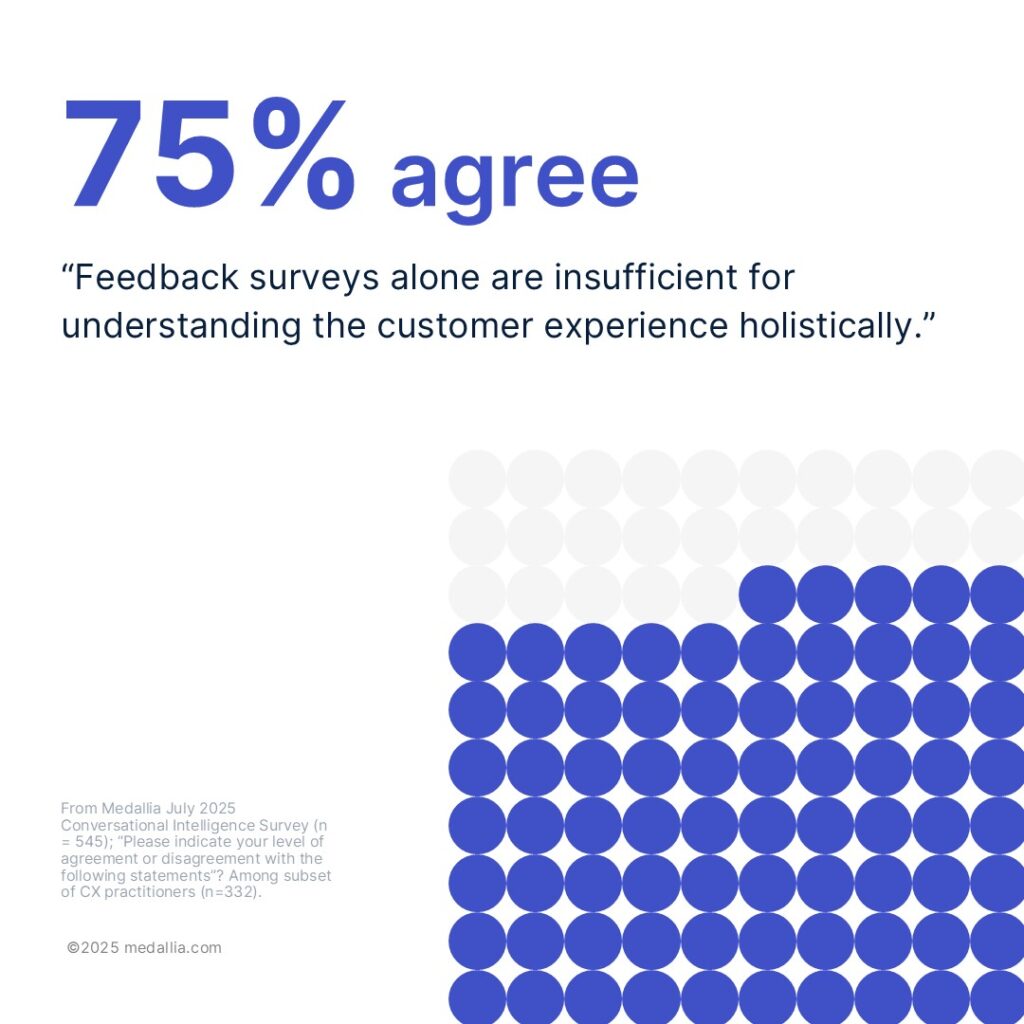
Our research shows that most CX practitioners agree: feedback surveys on their own don’t provide a complete picture of the customer experience. Think about it — surveys only capture the people willing to respond, after the fact, and only to the questions you chose to ask. A customer might have had an incredibly frustrating experience in a chat session, but unless you ask the right question in just the right way, you’ll never hear about it in survey form.
The implication is that organizations leaning too heavily on surveys risk flying blind to the real drivers of loyalty or churn. Contact center transcripts, support calls, and even digital behavior data often reveal things customers would never take the time to type into a survey box: repeated confusion about a billing policy, subtle frustration with a chatbot, or early signs that a customer is about to leave. These missed signals add up to blind spots that can distort how leaders prioritize investments.
The recommendation: Think of survey data as just one of many necessary pieces.
Instead of making them the centerpiece of your program, use them as one of several inputs that confirm or challenge what you see elsewhere. Pair survey data with conversational intelligence from service calls and chats, and with digital analytics that capture what customers actually do. That mix provides a much more accurate, timely view of experience than surveys alone ever can.
Conversational intelligence is already a competitive differentiator
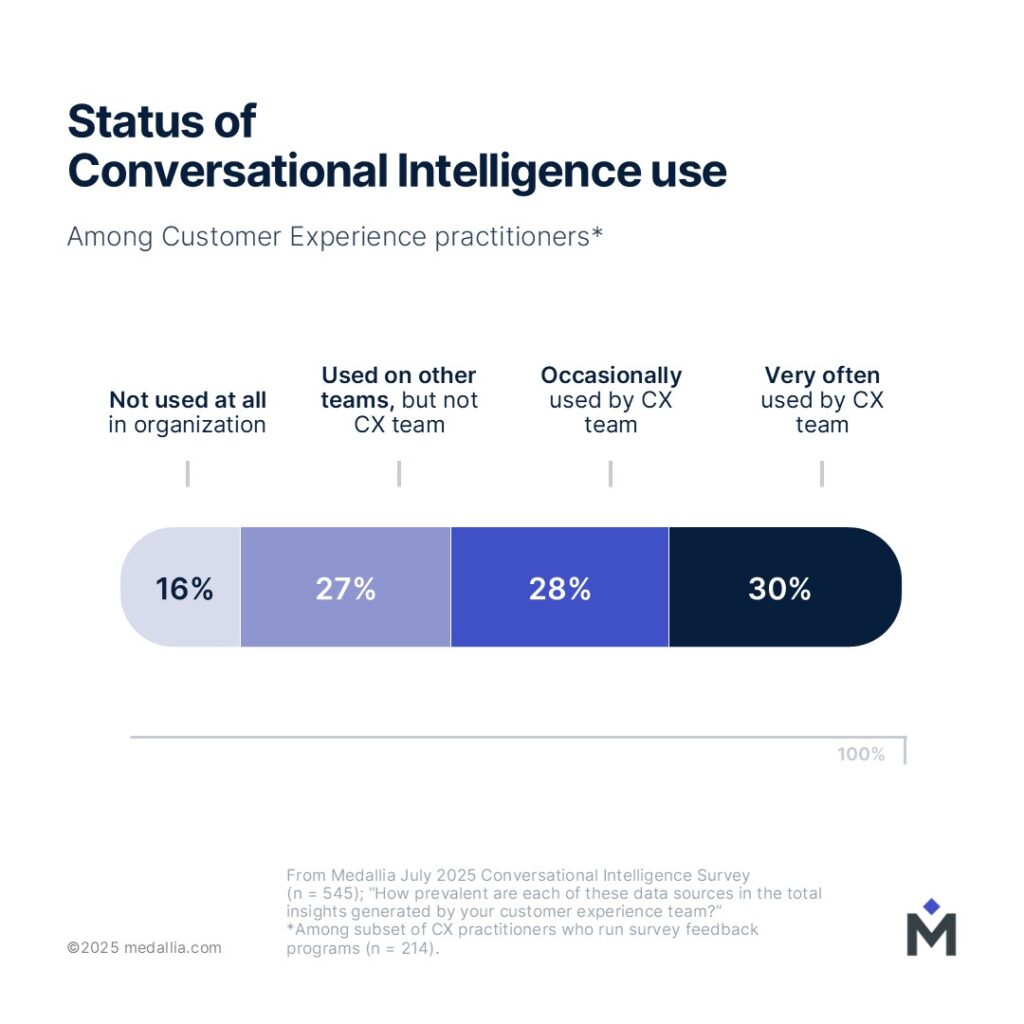
Our research highlights a sharp divide: leading CX programs are six times more likely to be heavy users of conversational intelligence than lagging programs. That’s not a small edge — it’s the difference between organizations that are advancing the field and those struggling to keep up.
And when we look closer at those who have already adopted CI, the value is undeniable. Nine out of ten CX teams using conversational intelligence rate it as valuable or highly valuable. In other words, once teams bring CI into their toolkit, it quickly proves its worth and becomes a capability they don’t want to lose.
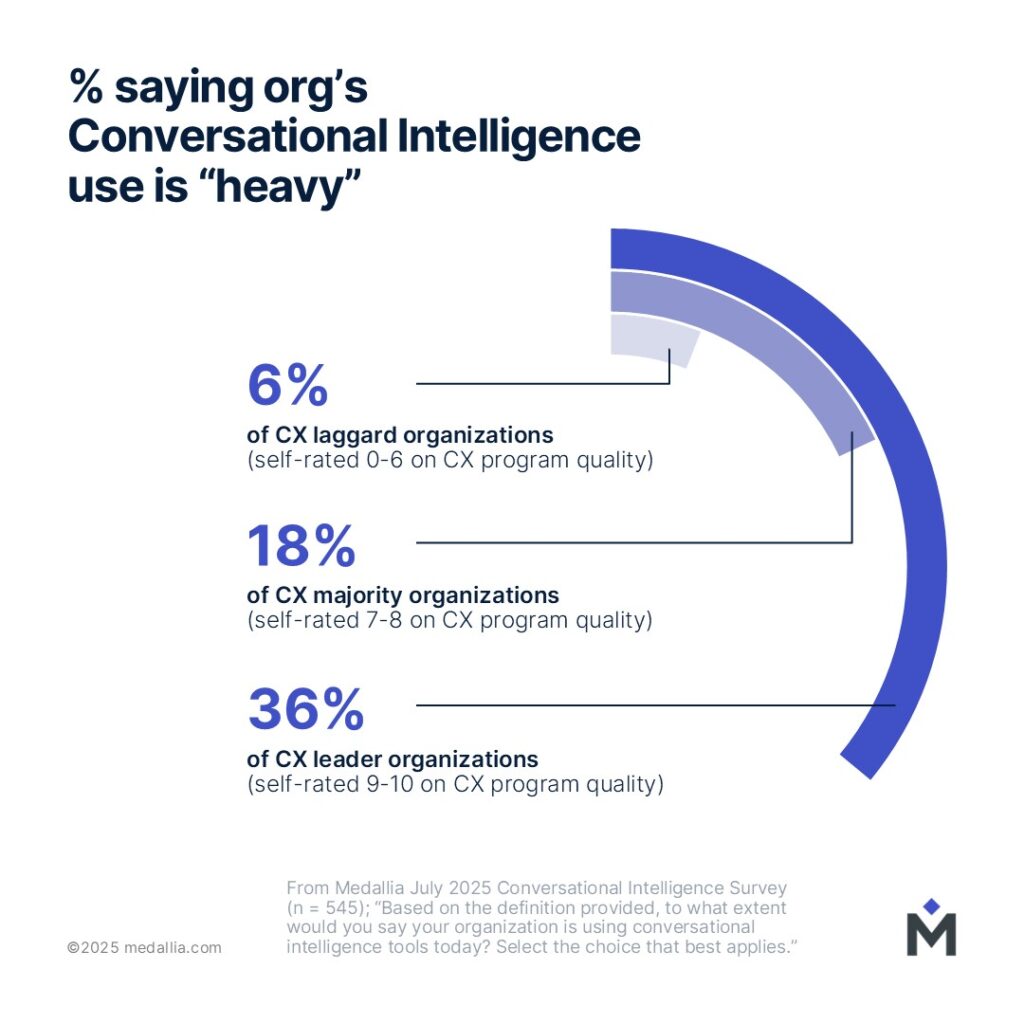
The recommendation: Prioritize conversational intelligence as a core capability, not a side experiment.
If your CX program is dabbling in conversational intelligence or hasn’t yet invested, you’re already behind those who are building strategy around it. Apply CI first to high-volume journeys like support calls, onboarding chats, or cancellation requests to demonstrate early wins. From there, expand rapidly to keep pace. Just as importantly, look outside your own four walls for inspiration.
Competitors who harness CI effectively will set the standard and be evident to outside observers in how they display continuity of customer history across touchpoints and close the loop following them. Customers will begin to expect that level of seamlessness everywhere, and to stay on par, your organization will need to think of CI as seriously as any other capability used in service interactions.
Inter-department silos are a major barrier to more widespread use
Despite its proven value, most CX teams aren’t using conversational intelligence often. And it’s usually not because the organization lacks the capability. More often, other teams, like those in contact center or operational departments, are already tapping into CI more regularly, but they aren’t involving the CX function. In fact, this is twice as likely to be the case as the organization not having CI capabilities at all! Valuable insights are being generated, but not shared where they could inform broader customer strategies.
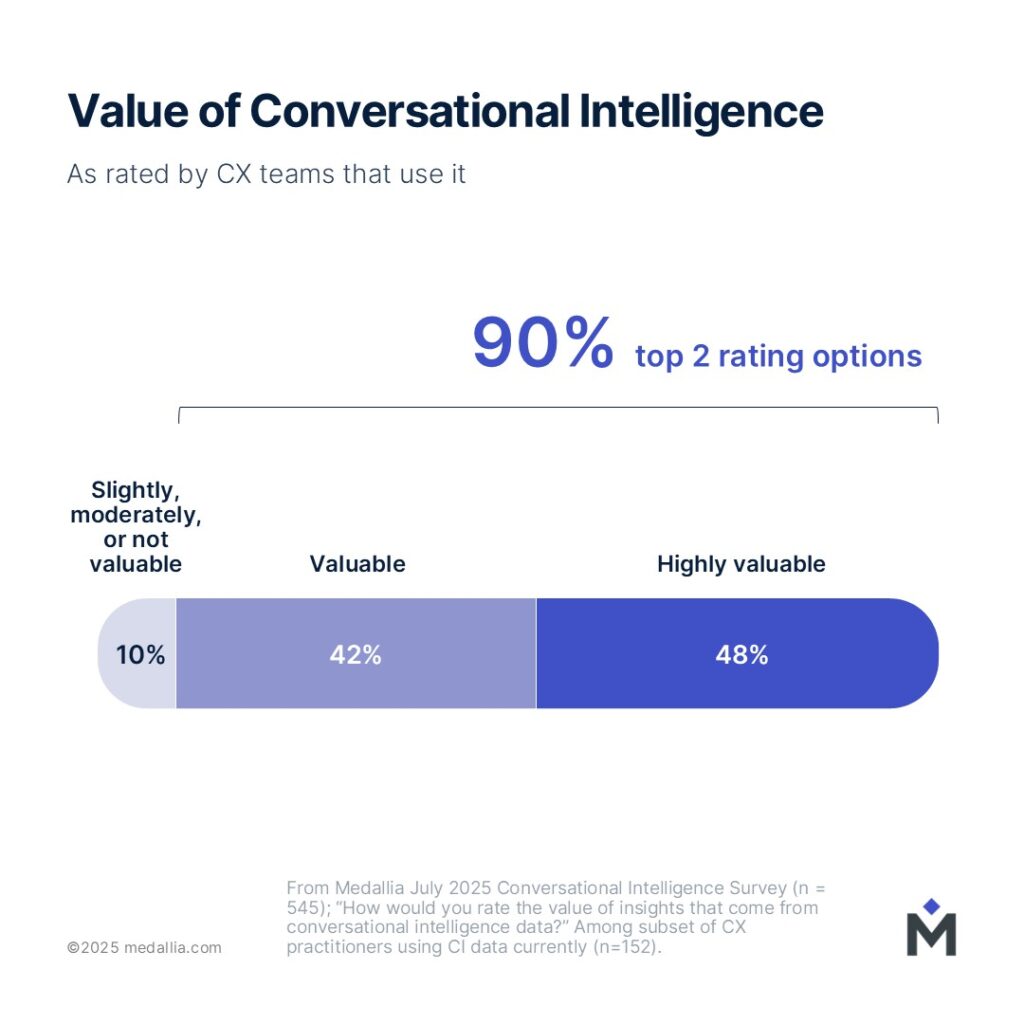
Practitioners know this is an issue, too. 81% of CX practitioners say their organization needs to do a better job sharing conversational intelligence data between teams.
On top of that, some other barriers to adoption are also worth noting. Practitioners cite data protection, tech integration, and skillset gaps as common obstacles. But there’s a telling split: CX professionals are far more likely to rank siloed information as a major barrier (4th highest factor) compared to their contact center counterparts (12th highest factor).
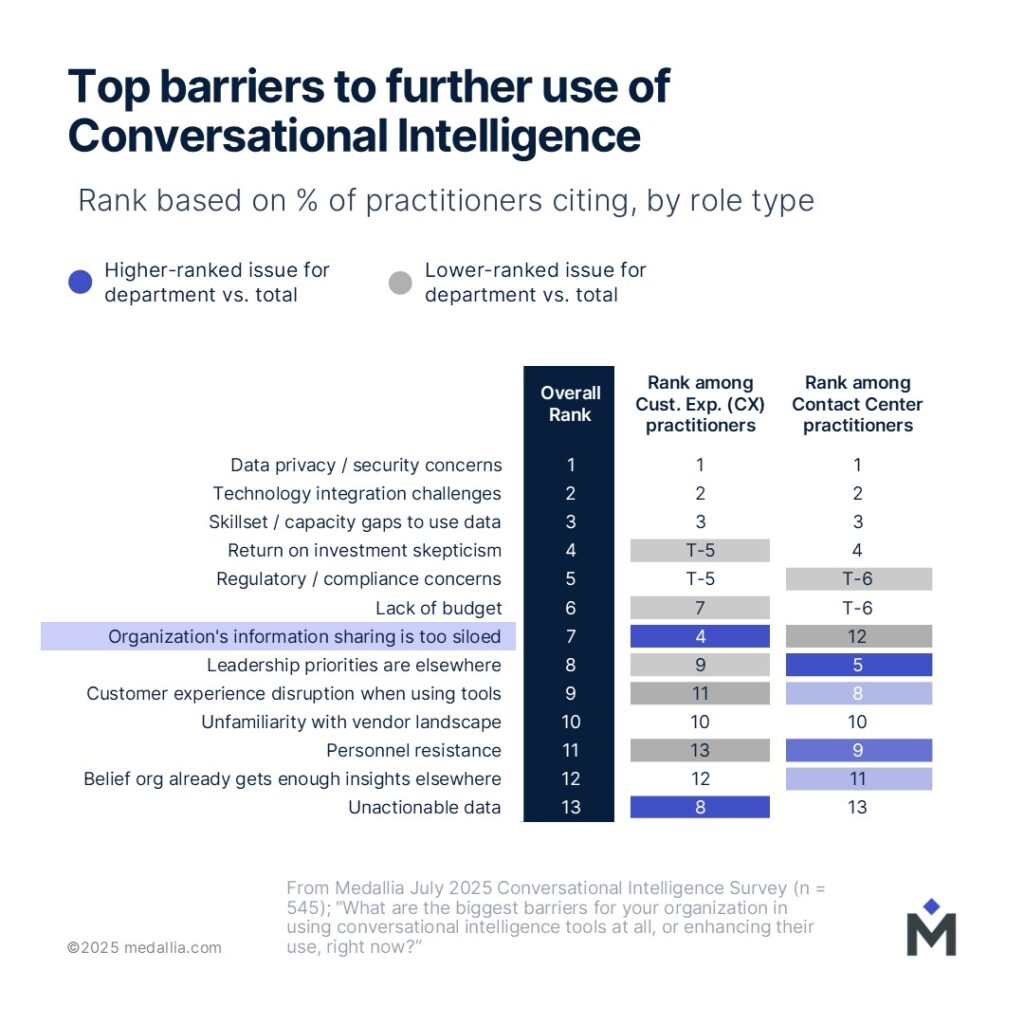
The recommendation: Break the silos before they break your program.
Start by mapping out who in your organization already owns or uses conversational intelligence. Build a cross-functional “insights roundtable” where the contact center, CX, and analytics teams share what they’re seeing — even if it’s a beta program at first. Don’t wait for perfect integrations; start with joint reviews of call transcripts or top themes from voice analytics.
From there, build toward shared platforms and governance that make CI insights accessible across teams. The payoff is twofold: you’ll accelerate adoption within CX, and you’ll also prevent competitors from outpacing you simply because their teams talk to each other better. Breaking silos isn’t a side project, it’s the first step toward using conversational intelligence as a true enterprise-wide capability.
Getting conversational intelligence from potential to practice
The research makes one thing clear: conversational intelligence isn’t a nice-to-have anymore. Surveys still matter, but they do not provide the complete picture. Leading CX programs are already leaning into CI and reaping the benefits, while laggards struggle to keep up. At the same time, barriers like silos, integration hurdles, and data protection concerns continue to slow progress.
But those obstacles aren’t insurmountable. The organizations that move now — and move deliberately — will set the pace for how customer experience is understood and managed in the years ahead. Consider getting started with these key steps:
- Reposition surveys as a component, not the centerpiece. Use them to confirm or challenge what you see in conversations and behaviors, not as the whole story.
- Make CI a core capability. Treat it like a must-have competency, on par with digital analytics or CRM. Pilot in the most important channels and use cases, then scale.
- Break down silos early. Create cross-functional forums where CX, contact center, and analytics teams share insights regularly, even before systems are fully integrated.
- Build comfort with the messy middle. Don’t wait for perfect tech or spotless data; start with what’s available, then refine processes and integrations over time.
- Look outside your own walls. Benchmark how peers and competitors are using CI in ways visible to the customer, and push to meet or exceed that standard.
The message for CX leaders is simple: conversational intelligence is already proving its worth. The only question is whether your organization will use it to lead or wait until competitive pressure forces you to catch up.
Surveys only tell part of the story. Download our latest research report to uncover the actionable insights and competitive advantage hidden in your contact center conversations.
Author