


How to Successfully Unify All Your Customer Experience Data [Template]

Wondering how to unify all your CX data to improve the customer experience, drive revenue, and cut costs? It starts with bringing together your company’s customer experience data, operational data, and financial data.
The information your brand needs to improve the customer experience, drive revenue, and cut operational expenses is right at your fingertips—in your company’s customer experience data, operational data, and financial data.
Bringing these data sources together will give you the full picture of what’s happening for your customers. It will help you better understand their wants, needs, expectations, and changing behavior, and these insights will ultimately help you:
- Identify opportunities to optimize existing products and services
- Unlock ideas for new products and services
- Get to the root cause of issues and solve them faster
- Enhance customer satisfaction, retention, and loyalty
- Increase revenue and gain a competitive advantage
Sounds great, right?
The problem is, getting all of your company’s data unified in one place is a major challenge. In fact, it’s one of the hardest parts of launching and running an omnichannel customer experience program, says Mary-Catherine Dolan, Senior CX Advisor at Medallia.
Fortunately, Dolan and her colleagues from our Medallia Experience Advisory have created a cheatsheet for making the complex process of CX data integration manageable.
This framework is based on the steps our Medallia Experience Advisory experts take to help leading global brands link their customer experience signals to operational and financial data to prove business impact. It’s available in our new playbook, Modern CX, Made Achievable: Your Step-by-Step Guide, and in our CX Data Integration Action Plan template.
We’ll walk you through this template so you can bring your data together to improve the customer experience, with insights from Amy Anders, Principal CX Advisor at Medallia, who is also one of the authors of the aforementioned playbook.
Unify Your Customer Experience Data to Improve the Customer Experience [Template]
Step 1: Map your universe
Anders suggests getting your team together for a group exercise around a virtual or physical whiteboard, examining your data ecosystem, and listing all of the systems that contain customer experience data, including your company’s:
- Web and app analytics
- Customer service systems (live chat, call logs, SMS, email)
- CRM and marketing tools
- Survey and research platforms
- Social and reputation management
- Sales and customer success tech
- Operational systems
- Financial systems
Get started by asking and answering the question: “What are all the pieces of information we collect about our customers and where do they live?”
Step 2: Go beyond CX signals
While survey data and other customer systems may be the first sources you consider mining for insights, operational systems and financial systems can reveal valuable clues about your customer segments, spend patterns, and more.
Bringing these data sets together along with your customer experience data can reveal how CX, operations, and financial outcomes are linked.
Step 3: Prioritize your data integration efforts with an effort vs. impact matrix
It’s impossible to integrate all of your data sources at once and even breaking the project into smaller tasks over time could end up taking a few years. So how do you decide where to get started?
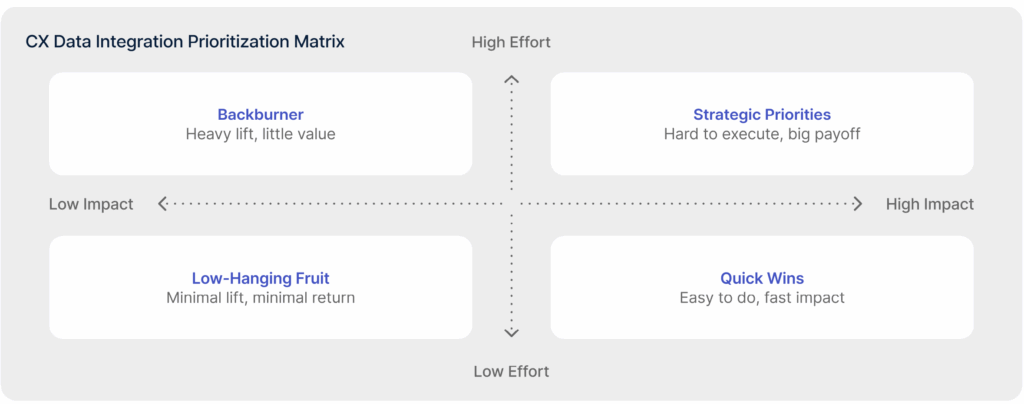
Use a matrix like this one pictured below to guide your process, suggests Anders.
Start with quick wins, data systems that are easy to integrate and will deliver a major impact on your understanding of the customer experience and your overall CX efforts.
Then work your way counter-clockwise, balancing strategic priorities that are harder to execute but deliver a big payoff and low-hanging fruit that involve only a minimal lift and minimal return.
Backburner integrations are systems that involve a heavy lift and offer little value, AKA ones you can save for last as time permits.
Customer Experience Data Integration Prioritization Matrix
Download the free CX data integration template
“Balance your time so that you’re working on some of those systems that are easy to take care of, but you’re also building a path toward tackling those harder ones,” says Anders. “That way, you’ll start to get momentum on your side. The more data you have, the more systems you have integrated, the bigger the payout.”
Step 4: Partner with IT and system owners early on
“Where I see teams struggle is when they don’t build relationships with system owners and IT,” says Anders. “They’re left out of the loop when systems and processes change and don’t have a champion to help secure data integrations.”
Step 5: Keep it manageable
CX data integration is a marathon, not a sprint. You don’t have to—and won’t be able—to complete the entire process at once. Know that some of your efforts could take a few years before you realize the benefits.
Here’s the truth: Most CX teams don’t have the customer experience data they need
A recent Medallia Market Research survey of CX professionals found that 75% agree that “customer feedback surveys alone are insufficient for understanding the customer experience holistically.” Put simply, most teams are missing critical CX signals that could otherwise help them improve the customer experience.
Bridging the gap starts with moving beyond surveys and gathering omnichannel signals from across channels and sources, including:
- Online review websites
- Social media comments and mentions
- Contact center calls, emails, and live chat sessions
- Point of sale (POS) system data
- Visit patterns
- Event data
- Digital experience analytics
- Operational and behavioral data
If you’re ready to take your data integration to the next level so you can harness the power of your customer experience data to improve experiences, deliver revenue growth, and cut costs, be sure to get your copy of our downloadable template: How to Make Modern CX Real for Your Organization: Your Data Integration Action Plan.
Plus, check out the complete playbook Modern CX, Made Achievable, which is packed with even more templates you can use to launch a top-tier omnichannel CX program.
Author